It is more cost-effective to build large, energy-efficient data centers with high-density racks.
Statistical data on the data center services market in Kazakhstan
The data center construction sector is characterized by a number of contradictions. Here are some of them:
The data center business has a high barrier to entry. Capital expenditures can amount to tens of thousands of dollars per server rack. At the same time, the sector is characterized by high demand, a shortage of supply, and steady investment growth. In other words, entering this business is not easy. However, if an investor is willing to provide sufficient funding, the business is profitable, provided the project is implemented correctly and on time;
High demand is confirmed by the following statistical fact: according to IKS Media, revenue from commercial data center services in Kazakhstan grew by 36% in 2021 compared with 2019. This was despite the fact that revenue from these services accounted for no more than 3.5% of total IT services revenue. In other words, compared with other areas of IT, the commercial data center business does not appear particularly attractive to investors because of its low profitability. However, commercial data centers generate stable profits—the average service life of a data center can reach ten years or more;
Growing investment in the data center construction market is evidenced by the expanding cloud services market. On average, it has grown by 38% year over year in tenge terms. Here, we are seeing "dynamic growth without an explosive effect." While the government remains the primary investor in data center construction in Kazakhstan, the rules of the game are gradually changing, and financial institutions are developing various instruments for private investors, including funds, bonds, hedging, and more;
And one more interesting observation: the structure of Kazakhstan's cloud market is dominated by IaaS (more than 70%), while in Russia, a larger share is occupied by SaaS. The reasons for this trend are obvious—Kazakhstan is lagging behind its northern neighbor in technological development.
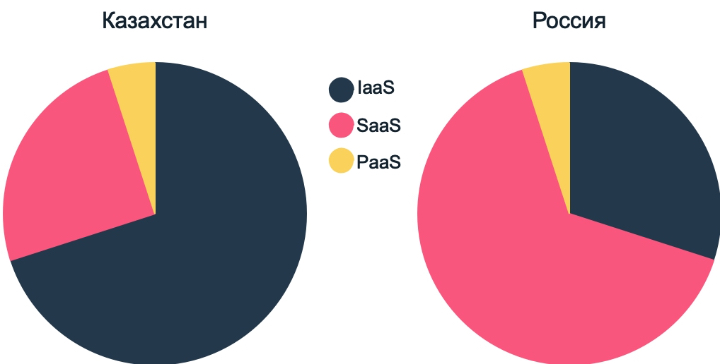
Source: IKS Media
The contradictions do not end there. It may seem that, given such substantial investments, the decision to build a data center should be carefully considered. After analyzing our own experience of working with customers on data center construction projects, we reached the following conclusion:
Most prospective data center owners keep making the same mistakes.
In this article, we have collected the most common misconceptions and attempted to substantiate each one.
Any business can succeed, provided it meets one simple condition: it must be profitable. The contradiction here is that most prospective data center owners regard profitability as a self-evident fact that will remain stable throughout the entire future operating period of the data center. I can understand the luxury of such a mindset if we disregard the growing competition. The experience of developed countries clearly shows that even government-owned companies ultimately have to engage in fierce competition. The conclusion is that prospective data center owners should consider reducing the cost of commercial data center services as early as the planning stage.
So, if you are a prospective cloud provider planning to build a data center, you will benefit from using the following criteria as a guide.
It is more cost-effective to use high-density racks
The power density of IT racks has a significant impact on the choice of engineering infrastructure, including the layout, cooling architecture, and power distribution. If operators significantly underestimate density, the facility may encounter problems deploying the latest IT systems, or run out of electrical capacity before the data hall is fully occupied.
Density directly affects the PUE value—the more efficient a facility is by design, the more likely it is to have a higher modal average power density. This is because large data centers are generally newer and better optimized for efficiency
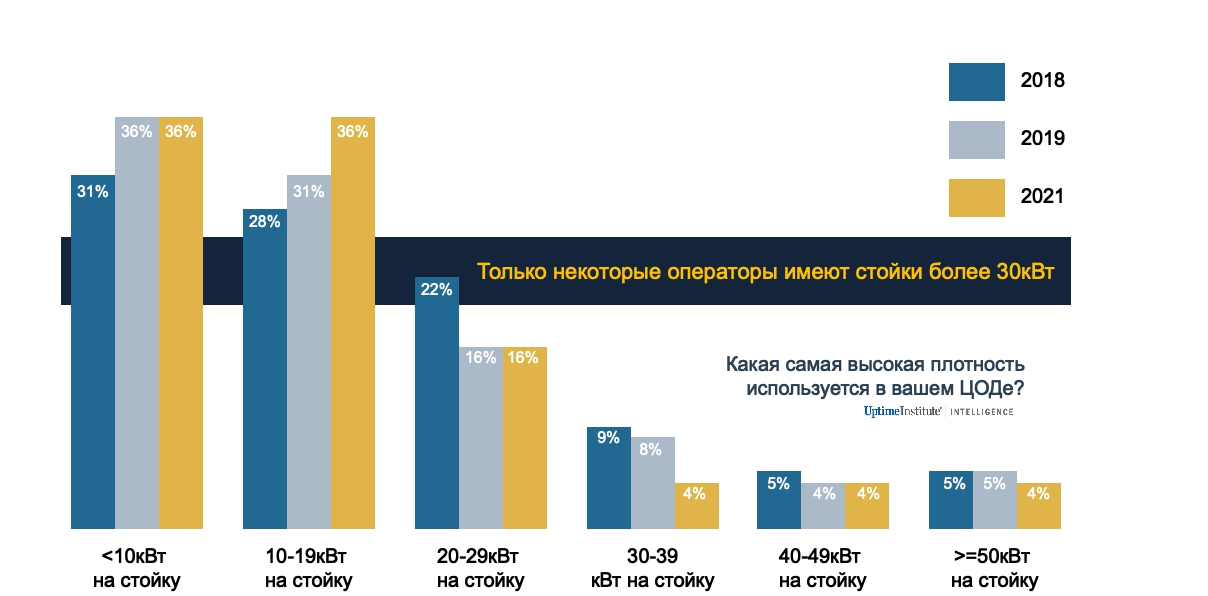
Source: Uptime Institute intelligence report 51
In data centers with an annual PUE above 1.6, relatively low-density racks of 5 kW or less predominate. In data centers with a PUE ranging from 1.3 to 1.6, racks rated from 5 to 10 kW are predominant. And nearly one in six data centers in this group with a lower PUE uses racks rated at 10 kW or more as standard practice.
It is more cost-effective to build resilient data centers
In recent years, the IT industry has embraced the following view: cloud computing—whether private or public—will transform the IT industry so that computing capacity becomes highly flexible and can be automatically redirected from a failed site to an operational one. For this reason, the infrastructure of an individual data center does not need to be as resilient as it was in the past.
However, there is an opposing view: increasingly critical computing tasks are now being performed in data centers, while the software that controls these operations is not always transparent, is highly complex, and may be susceptible to configuration errors. Moreover, failures of major components can trigger a cascading effect, making disaster recovery extremely difficult and costly. For this reason, it is important to have highly resilient infrastructure.
The latter argument prevails. While suppliers and designers are seeing a slight decrease in the number of data centers with 2N redundancy, the past three years have also shown a steady trend toward upgrading redundancy from N+1 to N+2. This applies not only to power systems but also to cooling systems.
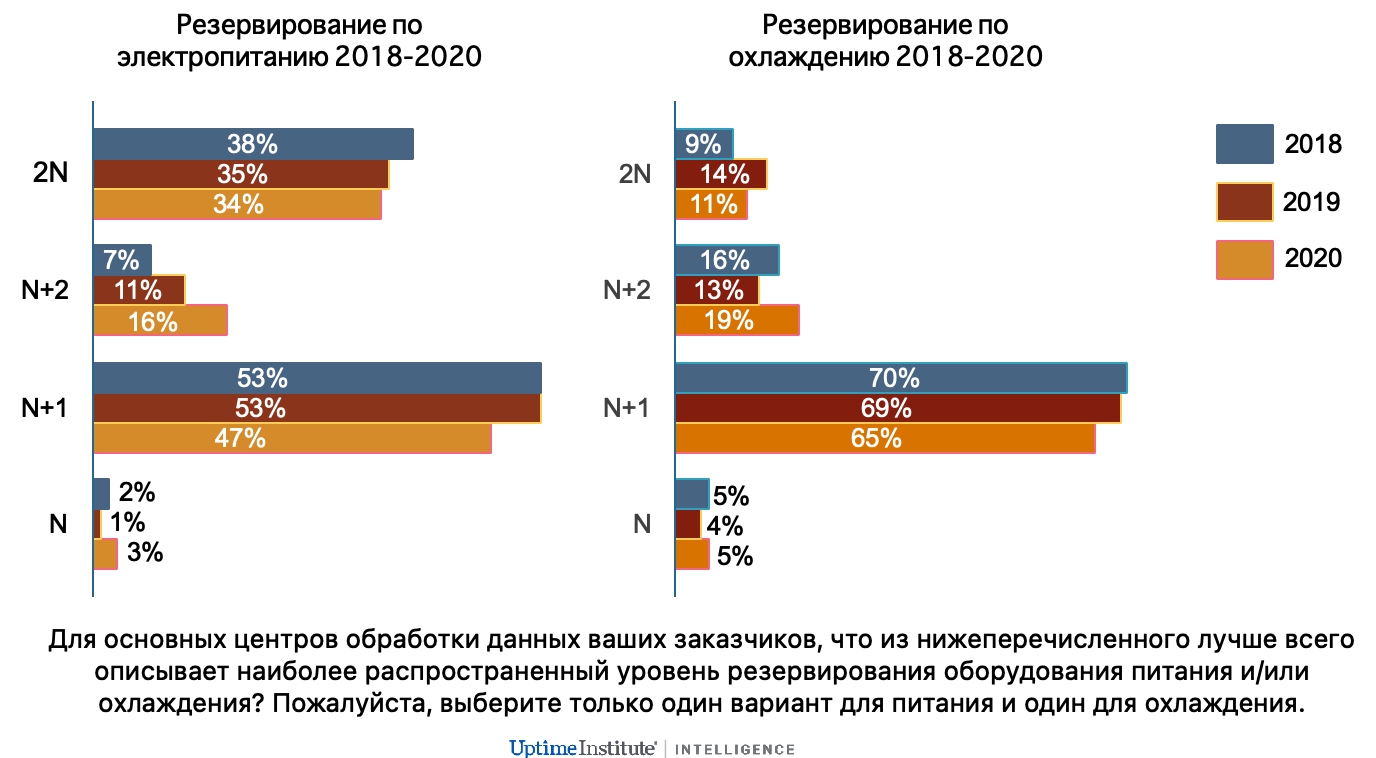
In addition to the relationship between server rack density and PUE, the Uptime Institute has also identified a relationship between power density, size, and data center efficiency.
At facilities with a maximum IT load of more than 3 MW (megawatts), there is a shift toward more powerful server racks, from 5 to 10 kW, compared with smaller facilities. Rack deployment density is generally even higher in data centers with a capacity of more than 5 MW.
Another shift occurs at the largest facilities, those exceeding 30 MW: racks in the 10–20 kW range are far more common than racks rated below 5 kW. One likely explanation is that facilities of this scale typically serve cloud and Internet companies—whether as an owned site or a colocation data center—which generally prefer fully populated cabinets equipped with high-performance IT equipment.
At the online conference held in October this year "Data Center—The Silk Road" several interesting analytical findings were presented.
One of them was as follows:
The smaller the data center, the longer its payback period. Consequently, the investment recovery period is longer and financial efficiency is lower.
As confirmation, an IKS Media analyst presented changes in the investment project's performance parameters, taking into account the key parameters of the data center construction project.
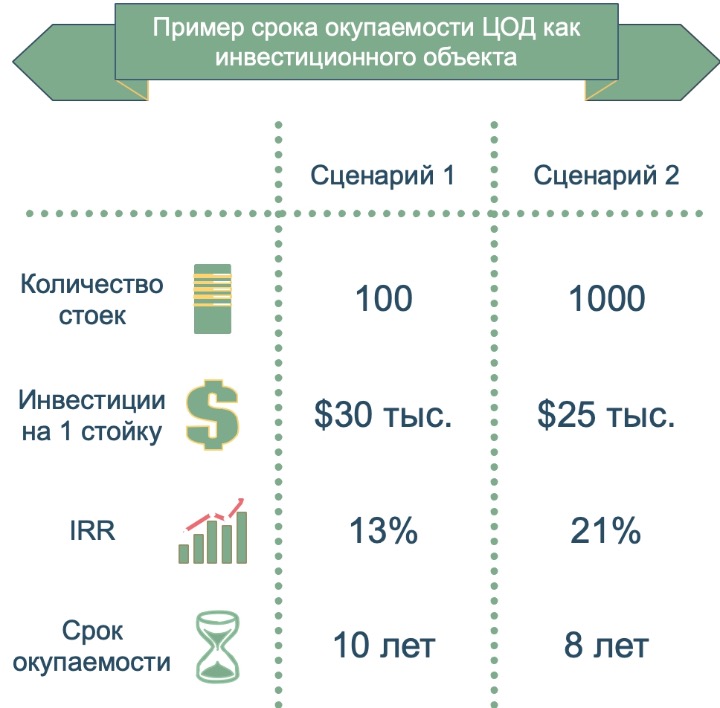
Source: IKS Media
As the number of server racks in your future data center increases, you not only reduce investment per rack, but can also expect higher revenue (an average of 25% more per month). At the same time, the project's payback period will be reduced by several years.
Of course, when presenting an investor with such attractive financial metrics, it is important to bear in mind that these conditions will work only if your data center meets all modern fault-tolerance requirements (a fault-tolerance level of at least Tier III) and uses high-density server racks (5kW or more). Therefore, all of the above criteria can easily be summarized as a single comprehensive criterion:
It is more profitable to build large, energy-efficient data centers with Tier III fault tolerance and a large number of high-density racks.
What conclusion can a future data center owner draw? One of the main ways to reduce the cost of cloud provider services is to improve the energy efficiency of their data centers. Improving energy efficiency means using high-density racks fully equipped with high-performance IT equipment. Increasing IT rack density is generally more feasible in one large data center than in several small ones.
When discussing energy efficiency, subsequent operating expenses must also be taken into account—primarily electricity costs.
While CAPEX per rack is still used for calculations in Russia, the rest of the world already calculates CAPEX per kilowatt or megawatt.
A reasonable question arises: "where is the golden mean in the CAPEX-to-OPEX ratio? How can one determine whether a future owner will be able to find enough customers willing to install their servers in high-density racks at a commercial data center?"
Of course, there can be no definitive answer here. Success and the achievement of strategic goals in any business depend on the effective and successful operation of various business units working together—from marketing to finance, and from logistics to external partners and suppliers.
Vicom Plus's many years of experience in building engineering infrastructure for data centers significantly helps future owners of commercial data centers make the right strategic decisions.
This has become possible because we have developed a clear methodology for consulting services based both on the realities of Kazakhstan and on global experience in data center design and construction.