Recently held meeting of the Demonopolization Commission can, without exaggeration, be called sensational, as it will have extremely positive consequences for the domestic cloud services market. And this will happen in the very near future.

Background
Back in 2012, Tahir Takabaev—the owner of the first private data center in Kazakhstan— presented his vision of the challenges hindering the development of the domestic cloud infrastructure. In particular, he introduced the concept of a "port speed limitation," which means the artificial and deliberate throttling of Internet speeds for domestic businesses, coupled with high tariffs. At the same time, individuals are provided with Internet at maximum speed. This has resulted in almost all traffic consumed by Kazakhstanis coming from abroad, while domestic platforms—including domestic business applications—have not received the development they deserve.
In other words, just as our oil industry is configured to pump crude oil “there,” our telecommunications industry is configured to pump traffic “from there”
The Paradoxical Cloud
The prerequisites outlined above have led to a paradoxical situation in the domestic cloud market: when comparing the cloud markets of Kazakhstan and Russia in terms of population/GDP, our cloud market is undervalued by almost 10 (!) times. This conclusion was presented at the end of 2021 by a well-known analytical agency IKS-Media.
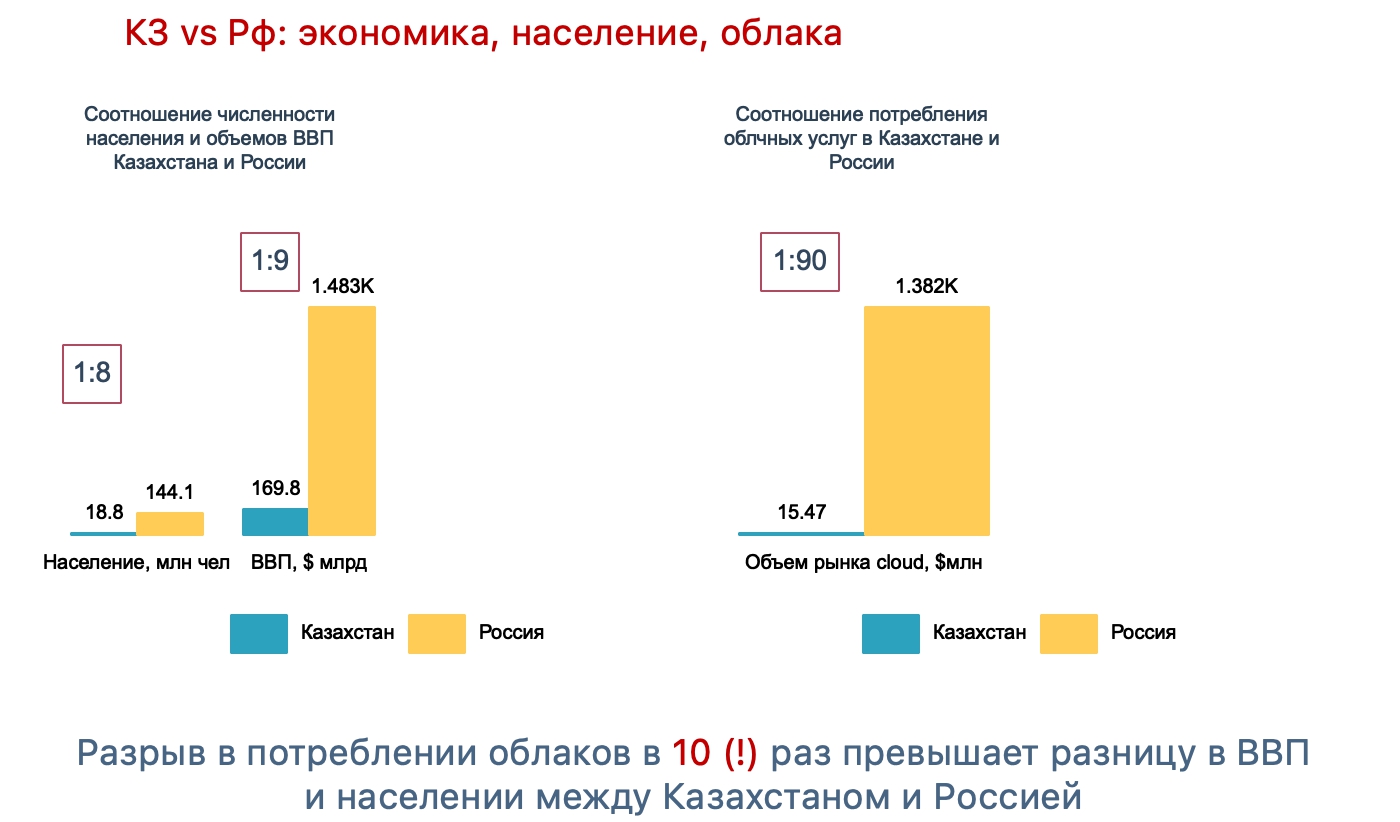
Even if we take into account the notorious "Yarovaya Law", and the fact that all popular social networks (Facebook, Instagram, VK), as well as popular cloud-based business platforms (1C, Bitrix, AMO CRM, etc.), are physically located in Russian or foreign data centers, even then the size of the domestic cloud market can safely be considered undervalued by at least five times.
"...As I have already said, there are currently 50,000 racks in commercial operation in Russia. The population ratio between Kazakhstan and Russia is 1 to 10. In theory, we should have 5,000 racks. Even if Kazakhtelecom builds 12 data centers with 100 racks each, that would be 1,200 racks. There should be another 4,000 racks somewhere. Moreover, this is the current requirement (ed. – 2012) to match Russia proportionally. And the market there is not standing still."
Additional prerequisites
Cloud capacity has traditionally been based on the pace of data center construction. In turn, the data center construction market is characterized by two limiting factors:
High barriers to market entry. An investor—the future data center owner—must have substantial financial resources to build a multi-component engineering infrastructure;
"Long-term money." An investor—the future data center owner—must be able to "tie up" a sufficiently large amount of capital for an extended period (the average investment period is 7 to 10 years).
Ultimately, this situation has led to telecommunications operators dominating Kazakhstan’s commercial data center market. The independent data center segment has not yet gained sufficient market strength. Thus, according to B. Mussin, Minister of the Ministry of Digital Development, Innovation and Aerospace Industry, Kazakhtelecom alone accounts for up to 55% of the domestic cloud market. Naturally, in this situation, it is not in Kazakhtelecom’s interest to lower the cost of its cloud services or develop clear, transparent pricing plans for small and medium-sized businesses.
Forecasts
The growth dynamics of Kazakhstan’s cloud market indicate steady organic growth rather than a sudden surge. In 2019, the market grew by 24% compared with 2018. In 2020, the market grew by 31% compared with 2019, reaching almost $15.5 million in monetary terms.
It can be assumed that the demonopolization of Kazakhtelecom will lead to the development of several mobile and wired Internet providers, which, in turn, will result in lower tariffs and increased Internet bandwidth for small and medium-sized businesses. After that, the "natural course of business development" will take over. Alongside the development of domestic platforms featuring entertainment content, popular cloud-based SaaS solutions will become increasingly sought after:
Accounting services;
Electronic document management;
Cloud telephony;
Cloud-based video conferencing.
What makes us so confident?
Of course, this is only a forecast. A small population or the lack of domestic software development may seem like more obvious reasons for the low growth of Kazakhstan’s cloud market.
But in reality, the reason may be entirely different. I tried to suggest some alternative explanations that seemed obvious to me. In economics, defining the problem is often more important than solving it, because the main mistake is failing to identify the right problem.
We will see the consequences of the antimonopoly commission’s decision in the near future.